Ukraine says first day of peace talks with Russia ‘productive’
Zelenskyy expects talks to soon lead to another prisoner exchange.


Published On 4 Feb 20264 Feb 2026
Save
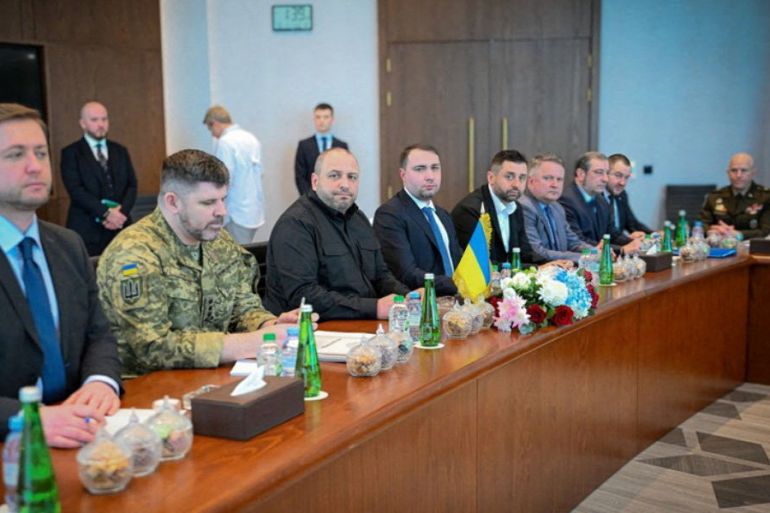
Ukrainian and Russian officials have wrapped up their first day of United States-mediated peace talks and are set to reconvene Thursday, according to Kyiv’s chief negotiator.
Rustem Umerov, the head of Ukraine’s National Security and Defence Council, described Wednesday’s negotiations in Abu Dhabi as “substantive and productive”. Talks are due to continue into a second day, his spokesperson Diana Davityan said, though no major advance towards ending the nearly four-year war was announced.
The positive outlook came despite fears the talks would be marred by a new wave of Russian attacks on Ukraine. Ukrainian authorities said the latest strikes included one that killed seven people at a crowded market, while others further damaged Kyiv’s power infrastructure amid freezing temperatures.
Nevertheless, the talks “focused on concrete steps and practical solutions”, said Umerov.

Negotiations must ‘genuinely move towards peace’
Ukraine’s President Volodymyr Zelenskyy, in an evening address, said it was imperative the talks yield concrete results and that he anticipated a prisoner exchange “in the near future”.
“People in Ukraine must feel that the situation is genuinely moving toward peace and the end of the war, not toward Russia using everything to its advantage and continuing attacks,” Zelenskyy said.
The Kremlin said that the “doors for a peaceful settlement are open,” but that Moscow will continue its military assault until Kyiv agrees to its demands.
Advertisement
The central hurdle in ending the war is the status of embattled eastern Ukraine, where Russia continues to make slow, painstaking advances.
Moscow is demanding that Kyiv withdraw its forces from large parts of the Donbas, including heavily fortified cities atop vast natural resources, as a precondition to any deal.
It also wants the world to recognise Russian sovereignty over territory it has seized in the war.
Kyiv is instead pushing for the front lines to be frozen at their current positions and rejects any unilateral troop withdrawal. Polls show that the majority of Ukrainians oppose a deal that hands Moscow more land.
“I think that Ukraine doesn’t have any moral right to give up our occupied territories … because my friends were fighting for that and they died for that,” Sofiia, a resident of Ukraine’s Poltava region, told Al Jazeera.
Unresolved issues ‘diminishing’
US Secretary of State Marco Rubio said it would likely take time to achieve a diplomatic breakthrough but claimed the administration of President Donald Trump had helped “substantially diminish” the number of unresolved issues between the warring parties.
“That’s the good news,” Rubio told reporters Wednesday. “The bad news is that the items that remain are the most difficult ones. And meanwhile the war continues.”
Ukraine’s Ministry of Foreign Affairs spokesperson Heorhii Tykhyi said Kyiv was “interested in finding out what the Russians and Americans really want”.
He added that the talks – only the second direct engagement between Ukrainian and Russian officials in more than three years – focused on “military and military-political issues”.
Russia occupies about 20 percent of Ukraine’s national territory, including Crimea and parts of the eastern Donbas region seized before the 2022 invasion.
Zelenskyy on Wednesday said that the number of Ukrainian troops killed since the start of the war stood at about 55,000, with a “great number” also missing in action.
Total wartime casualties, including both killed and wounded, are estimated to extend into the hundreds of thousands for both sides.